
A 43-year-old male patient presented with non-ST-elevation myocardial infarction (NSTEMI), a type of heart attack. Coronary angiography revealed significant narrowing in multiple coronary arteries. Following evaluation, the patient underwent percutaneous coronary intervention (PCI) with drug-eluting stent placement to restore blood flow in the affected arteries.
Patient Presentation and Risk Factors
The patient presented with NSTEMI and had several cardiovascular risk factors, including:
- Diabetes mellitus
- Family history of cardiovascular disease
- Family history of premature coronary artery disease (PCAD)
Diagnostic Findings
Coronary angiography was performed through the right radial artery, which is located at the wrist. The procedure identified significant coronary artery disease affecting multiple vessels.
The key findings included:
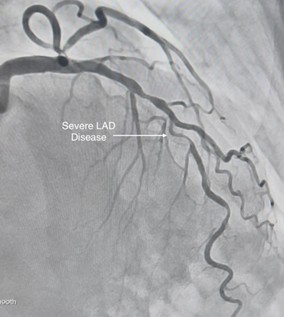
- Left anterior descending (LAD) artery: Severe narrowing in the mid portion, with additional narrowing in the distal segments.
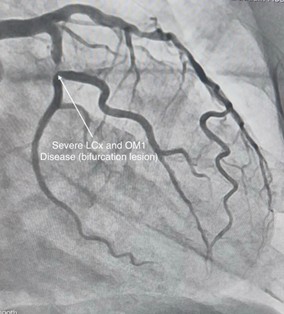
- Left circumflex (LCX) artery: Severe narrowing in the proximal segment.
- First obtuse marginal (OM1) branch: Severe narrowing at its origin. Bifurcationg lesion
- Right coronary artery (RCA) and Left main were non obstructive.
The findings indicated multivessel coronary artery disease, particularly affecting the LAD and LCX-OM1 regions.
LAD pre PCI
LCX pre PCI
Treatment Approach
Following the initial angiography, the treatment options of coronary artery bypass grafting (CABG) and multivessel percutaneous coronary intervention (PCI) were discussed with the patient and his wife.
After evaluating the patient’s coronary anatomy and treatment considerations, multivessel PCI was selected as the preferred approach. The procedure was successfully performed by Dr Danish Yar and the cardiology team at Dr. Ziauddin Hospital, involving stent placement in the left anterior descending (LAD) and left circumflex (LCX-OM1) arteries with complex techniques.
PCI is a minimally invasive procedure used to open narrowed coronary arteries. Drug-eluting stents are placed to help maintain blood flow and reduce the risk of the treated arteries narrowing again.
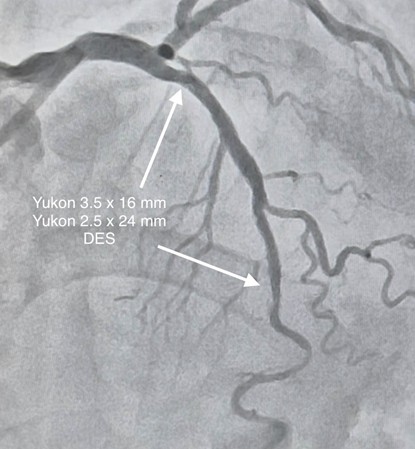
1. LAD was stented with two drug-eluting stents
- A 2.5 × 24 mm drug-eluting stent in the mid LAD.
- A 3.5 × 16 mm drug-eluting stent in the proximal LAD.
Balloon dilatation was performed before and after stent placement to prepare the artery and optimize stent expansion. The distal LAD lesion was managed medically.
2- PCI to the LCX-OM1
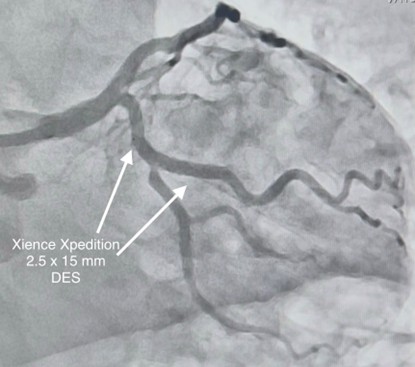
A 2.5 × 15 mm drug-eluting stent was placed in the OM1 branch.
A modified jail balloon technique was used to preserve the LCX side branch during stent placement. The final angiographic assessment showed a good result, with some residual narrowing at the origin of the distal LCX.
Clinical Outcome
The procedure was completed successfully, with good stent expansion and TIMI grade 3 blood flow, indicating normal flow through the treated coronary artery segments.
The patient was free of chest pain and hemodynamically stable at the end of the procedure. No procedural complications were reported in the PCI procedure notes.
Conclusion
This case highlights the assessment and treatment of multivessel coronary artery disease in a patient presenting with NSTEMI and multiple cardiovascular risk factors.
Following coronary angiography and evaluation of the treatment options, multivessel PCI was performed with three drug-eluting stents across the LAD and LCX-OM1 regions. The procedure achieved good angiographic results and TIMI grade 3 blood flow, with the patient stable and free of chest pain at its conclusion.